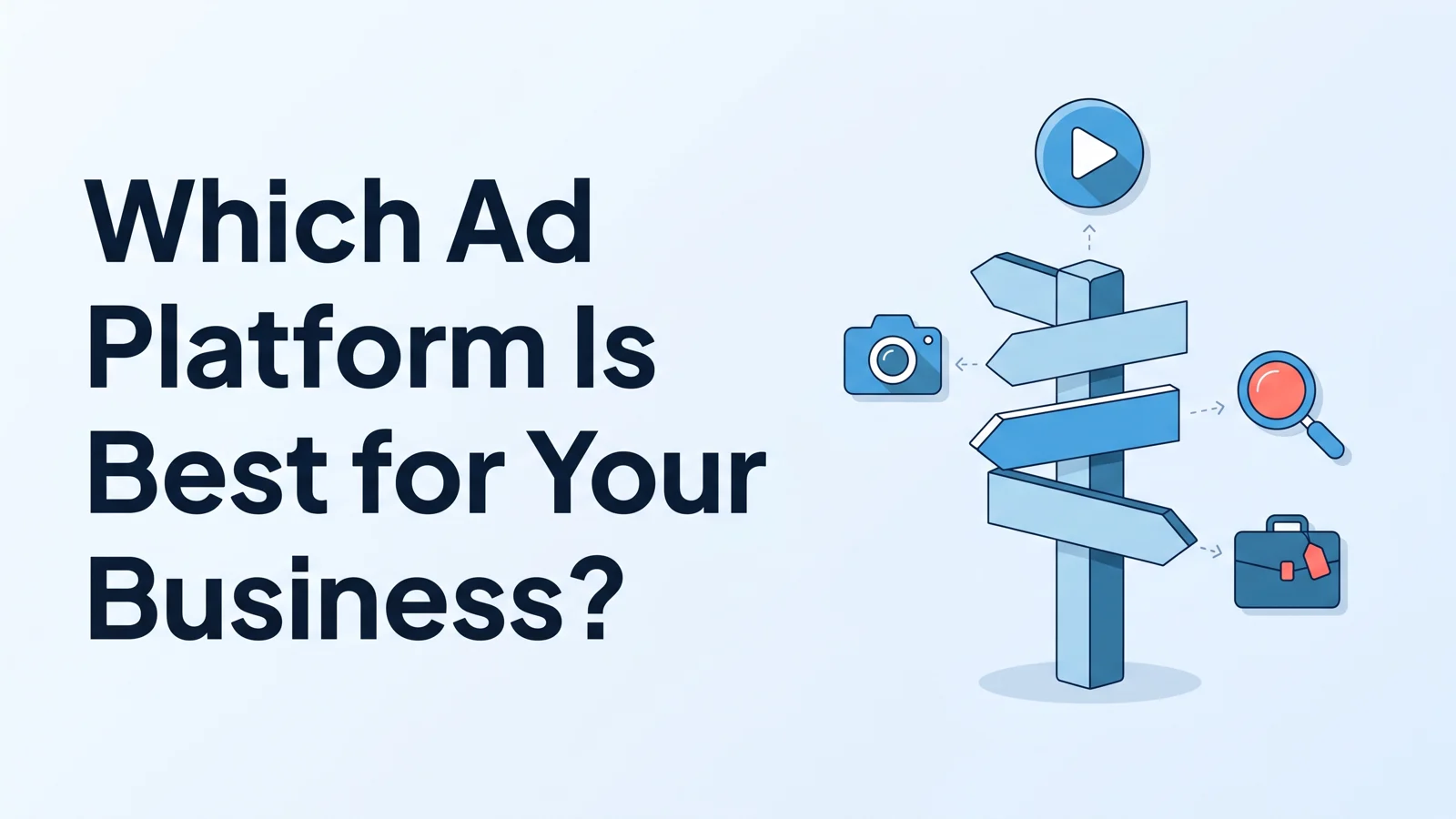
Which ad platform is best for your business? It is the first question most advertisers ask, and the honest answer is that it depends on what you sell, who buys it and what you want the campaign to do. Any tool can rank channels. The ranking is the easy half, and on its own it is close to useless: you cannot tell whether the model understood your product or simply repeated what is popular this quarter.

This guide sets out what each major platform is good at, how to match platforms to your objective, and how to tell a recommendation you can trust from one you cannot.
What each ad platform is good at
Every network reaches people in a different frame of mind. That, more than its size, decides whether it suits your business.
- Google Search reaches people who are already looking. It is strong for services, urgent needs and products people search for by name.
- Google Shopping shows your product, price and image at the moment of search. It suits online stores with a product feed.
- Meta (Facebook and Instagram) offers broad reach and detailed interests. It is strong for consumer products, local businesses and offers that look good in a photo.
- YouTube carries longer stories, demonstrations and explanations. It helps when the product needs showing.
- TikTok runs on short vertical video and rewards creative that looks native to the platform rather than polished.
- LinkedIn targets professionals by job title, industry and company. Clicks usually cost more, but for B2B the precision can be worth it.
- Snapchat is mobile-first and vertical, and popular with younger audiences, including in the Gulf.
- Email and WhatsApp reach people who already know you. They are best for repeat customers, follow-up and offers to an existing list.
Match the platform to the objective
The same business might choose different channels for different campaigns, because the objective changes what each channel needs to do.
- Sales: search and shopping capture demand that already exists; Meta and TikTok create new demand.
- Leads: search captures high intent, LinkedIn suits B2B, and Meta's lead forms work well for consumer services.
- Traffic: social feeds and display reach many people at a modest cost per visit.
- Awareness: video platforms and social feeds, where the creative can make an impression even without a click.
Why the reason matters more than the ranking
What makes a recommendation checkable is the reason attached to it. markXpand reads your product and your objective and recommends the channels worth paying for, and every card carries a written justification plus a suggested peak posting window. If the reason does not hold for your business, you drop the channel in a click and the budget rebalances.
A written reason lets you test the logic against what you know about your customers. If the reason says your audience spends time on Instagram and you know your buyers are procurement managers, you can see the mismatch immediately and act on it. A bare ranking gives you nothing to check.
Fewer channels, done properly
That matters most when the honest answer is fewer channels, not more. Spreading one modest daily budget across six networks usually buys six under-funded campaigns. Being able to read why a channel was suggested is what lets you make that call deliberately.
Each network's delivery system needs data to learn who responds to your ads. A budget split too thin starves every channel of that data at the same time, so none of them improves. Starting with two or three channels, giving each enough to learn, and adding more once one is working is usually the better order.
Questions to ask before you choose
- Where does my customer already go when they look for what I sell?
- Does my product need showing, explaining or simply finding?
- Can I produce the creative this channel needs, such as vertical video for TikTok and Reels?
- Is my budget enough to give this channel a fair test?
- Can I measure the result I care about on this platform?
- Do my competitors already advertise here, and can I offer something different?
If a channel fails two or more of these, leave it for later. It will still be there when the first campaign has taught you what works.
A simple way to start
Pick one channel that captures demand, usually search, and one that creates it, usually a social feed. Run both for a couple of weeks with a single objective, compare them on the same numbers, then move budget toward the stronger one. You learn more from two channels run properly than from six run at once.
Signs a channel is working
Give a new channel two to four weeks before judging it, then look for these signs:
- Spend delivering steadily, without long pauses in review.
- A click-through rate that holds or improves as the audience grows.
- Conversions arriving at a cost below your break-even.
- Results that repeat week after week, rather than one lucky day.
If a channel shows none of these after a fair test, move its budget to one that does. If it shows some of them, change the creative or the targeting before you give up on it.
When to add another channel
Add a channel when one is already working and you have budget to spare, or when your current channel stops growing. Add one at a time, so you can see what each new channel contributes on its own.
How markXpand helps you choose
markXpand considers nine networks (Google Ads, Google Shopping, Meta, Instagram, YouTube, LinkedIn, TikTok, Email and WhatsApp) and recommends only the ones worth paying for, each with a written reason and a suggested peak posting window. You can drop or add a channel in a click, and the daily budget rebalances across the ones you keep. Your first three campaigns are free, with no credit card.