There is now an AI tool for almost every step of a campaign: writing the headline, generating the image, choosing the audience, setting the bid and reading the report. That is the good news. The less obvious news is that the best AI marketing tools are not the cleverest ones in isolation. They are the ones that fit together, respect each network's rules and leave a person in charge of what goes live.
This guide sorts AI marketing tools by the job they do, explains what to look for in each group and ends with seven questions to ask before you choose. It does not rank brands, because the right answer depends far more on the shape of your team than on any benchmark.
The five kinds of AI marketing tools
Most products on the market fall into one of five groups. Many businesses end up with one tool from each group, which is exactly where the trouble starts, as the section after the list explains.
1. AI copywriters
General writing assistants and dedicated ad-copy tools draft headlines, descriptions, captions and emails in seconds. They are excellent at volume and variation, which matters because ad networks reward testing several versions of an ad rather than betting on one.
What to look for: does the tool know each network's character limits and asset counts, or will you be trimming every line by hand? Can it write in the languages your customers read, which in the Gulf usually means English and Arabic? And does it start from your actual product and brand, or from a blank prompt every time?
2. AI image and video generators
Image and video models can now produce product scenes, lifestyle shots and short clips that once needed a studio day. For advertisers the catch is format. Every placement wants its own ratio, and text or product details placed carelessly end up under a caption or outside the safe area.
What to look for: output made natively in 9:16, 1:1 and 16:9, rather than one image cropped three ways; your real product in the frame rather than a lookalike; and creative you can edit and regenerate, not just accept or reject as a whole.
3. Ad platform automation
Google and Meta build AI into their own campaign types, and Google's Performance Max and Meta's Advantage+ are the best known. They are strong at bidding and delivery inside their own network, and they learn from more auction data than any outside tool can see.
What to look for: these tools optimise only their own network, so they cannot tell you whether the next dirham belongs on Google, Meta or TikTok. You still need something above them to choose channels, split the budget across networks and compare the results on one definition.
4. AI research and analytics tools
AI research tools summarise competitors, keywords and audiences; analytics tools pull performance together and flag what changed. Both save hours, and both are only as useful as their connection to the next decision you have to make.
What to look for: research that names the rivals you actually have and what they are running now, not a generic category report; and reporting that puts every channel on one set of numbers (spend, clicks, CTR, conversions and cost per acquisition) with a recommendation attached, rather than another chart to interpret.
5. All-in-one AI marketing platforms
The newest group joins the steps above into a single flow: brief, research, channels, budget, copy, creative, launch and reporting. The appeal is less about any one feature and more about context. The copy knows the objective, the creative knows the placement and the report knows what was planned.
What to look for: which channels the platform can actually launch to, whether campaigns run in ad accounts you own, and how approval works before anything spends.
The hidden cost of stitching tools together
A stack of separate tools can each be excellent and still produce a weak campaign. The copywriter does not know which channels were chosen, the image tool does not know the copy, the budget lives in a spreadsheet and the results arrive in five dashboards with five definitions. Someone on your team becomes the glue, carrying context from one tab to the next.
For a small team, that glue work is often what stops campaigns from launching at all. Before adding another tool, count how many times the same brief gets retyped on its way from idea to live ad.
How to choose: seven questions
Before you sign up for anything, ask these questions about each tool on your shortlist:
- Does it start from your product and brand, or from an empty prompt?
- Does it follow each network's limits and formats without manual trimming?
- Can it work in English and Arabic if your customers read both?
- Do campaigns run in ad accounts you own, so the data and history stay yours?
- Who approves before money is spent, and can a reviewer reject with a written reason?
- Can you compare every channel on the same numbers afterwards?
- What does it cost compared with what you pay now in agency fees or staff time?
If a tool fails the approval question, be careful however good its output looks. AI drafts quickly and confidently, and an unreviewed mistake costs real budget.
Where markXpand fits
markXpand is an all-in-one AI marketing platform. You choose what the campaign is for; it researches your competitors live, recommends channels with a written reason for each, splits the daily budget into figures you can edit, writes copy per platform and per placement, and generates creative in each ratio. It launches to Google Ads, Google Shopping, Meta, Instagram, YouTube, LinkedIn, TikTok, Email and WhatsApp, inside your own accounts.
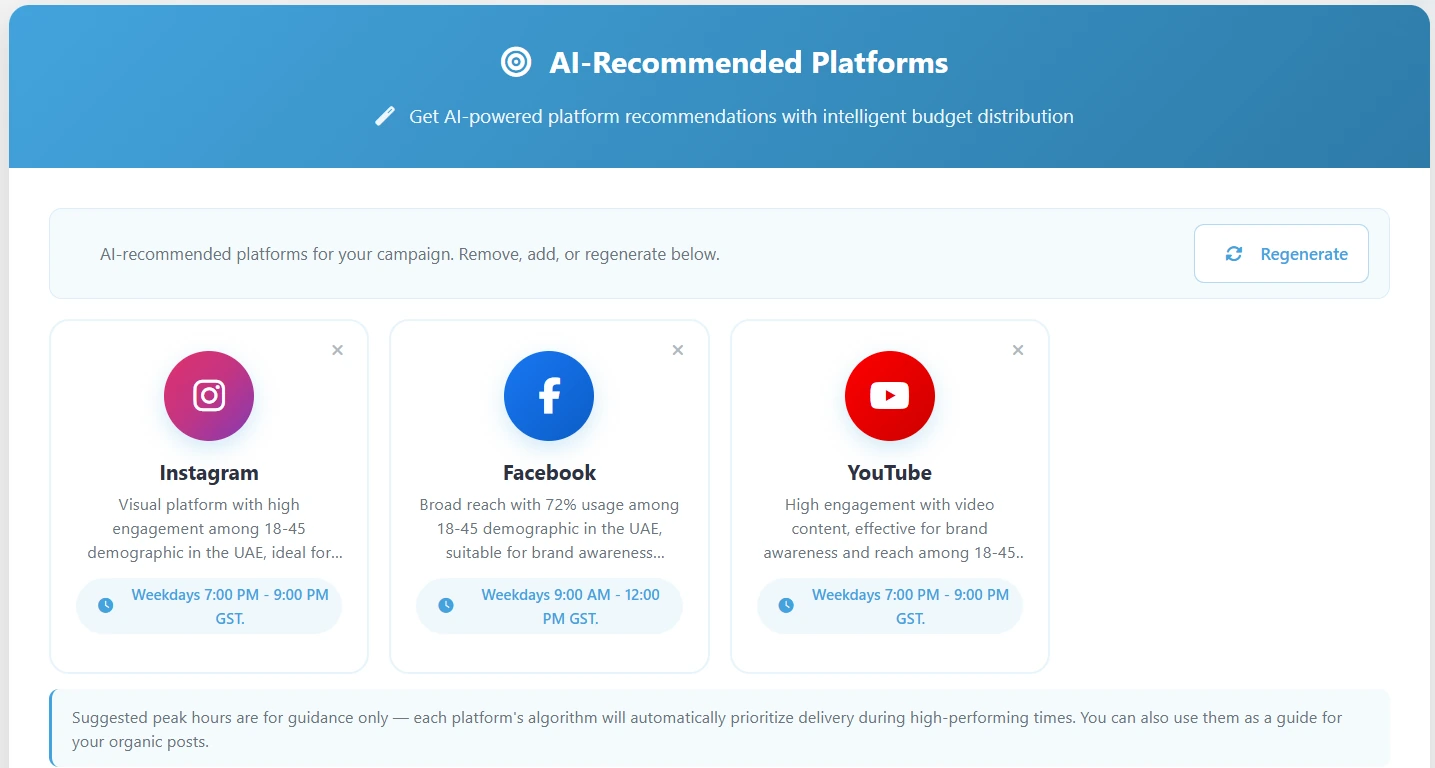
An owner approves once, every ad arrives paused, and results come back on one set of numbers with suggestions written against your own figures. It runs in English and Arabic. If you would rather test it than read about it, your first three campaigns are free, with no credit card.